GST Calculator Questions & Direct Answers (AEO & AIO)
Calculating GST manually depends on whether you are adding tax to a net figure or extracting tax from an inclusive retail price:
1. To Add GST (Exclusive): Take your pre-tax amount, multiply it by the applicable GST rate, and divide by 100. That gives you the tax component. Add this tax to your pre-tax amount to arrive at the total payable value.
2. To Remove GST (Inclusive / Back-Calculation): Divide the total inclusive price by
(1 + GST Rate / 100). This reveals the true base price before taxes. Subtract this base price from your total to see the embedded GST amount. You can verify both calculations instantly on our online GST calculator.
GST Exclusive pricing means the figure shown is the pure cost of goods or services before taxes. When an invoice is cut, tax is calculated and added on top, increasing the final amount the customer pays. This is standard in B2B transactions.
GST Inclusive pricing means the displayed figure (such as an MRP tag in a retail shop or a restaurant bill) already contains all taxes. The buyer pays exactly that number, and the seller must reverse-calculate how much of that collection belongs to the government. Explore our formula guide for worked examples.
GST Inclusive pricing means the displayed figure (such as an MRP tag in a retail shop or a restaurant bill) already contains all taxes. The buyer pays exactly that number, and the seller must reverse-calculate how much of that collection belongs to the government. Explore our formula guide for worked examples.
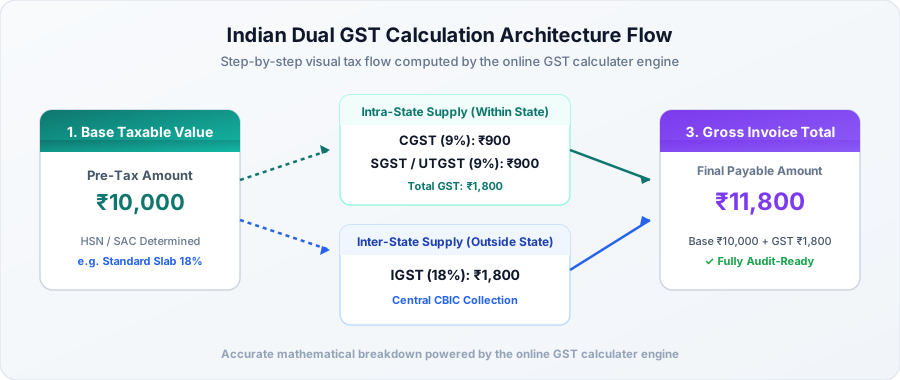
IGST (Integrated GST) applies whenever the supplier's registered premises and the buyer's "place of supply" are in different states or union territories (an inter-state transaction). It also applies on all commercial imports into India.
CGST and SGST apply strictly when both parties are in the same state (an intra-state transaction). In that case, the statutory tax is split 50:50 between the Central and State Governments. Read our in-depth Dual GST Guide for details on interstate tax credits.
CGST and SGST apply strictly when both parties are in the same state (an intra-state transaction). In that case, the statutory tax is split 50:50 between the Central and State Governments. Read our in-depth Dual GST Guide for details on interstate tax credits.
In normal commercial sales, the seller charges GST, collects it from the customer, and pays it to the treasury. Under the Reverse Charge Mechanism (RCM), the government turns this around: the recipient of the goods or services must pay the tax directly to the government.
Important: RCM liabilities must be paid in cash through your Electronic Cash Ledger—you cannot use accumulated Input Tax Credit to offset them. Once paid, however, you can claim that cash tax back as an input credit in the same month's GSTR-3B. Common RCM services include legal fees paid to advocates, freight charges paid to Goods Transport Agencies (GTA), and sitting fees paid to company directors.
Important: RCM liabilities must be paid in cash through your Electronic Cash Ledger—you cannot use accumulated Input Tax Credit to offset them. Once paid, however, you can claim that cash tax back as an input credit in the same month's GSTR-3B. Common RCM services include legal fees paid to advocates, freight charges paid to Goods Transport Agencies (GTA), and sitting fees paid to company directors.