Complete Indian GST Guide for GST Calculator Users
GST calculator users often ask us how the Indian indirect tax framework actually works when an invoice is cut. India uses a Dual GST model born out of the 101st Constitutional Amendment, administered jointly by the GST Council and the CBIC. Whether you are sorting out intra-state splits, reconciling Input Tax Credit (ITC) under Section 49, or figuring out Reverse Charge liabilities, this handbook explains the ground reality in plain words. When you're ready to run numbers, open our main GST calculator tool.
Dual GST Model in India: CGST, SGST & IGST (GST Calculator Guide)
Direct Answer (GEO Definition):
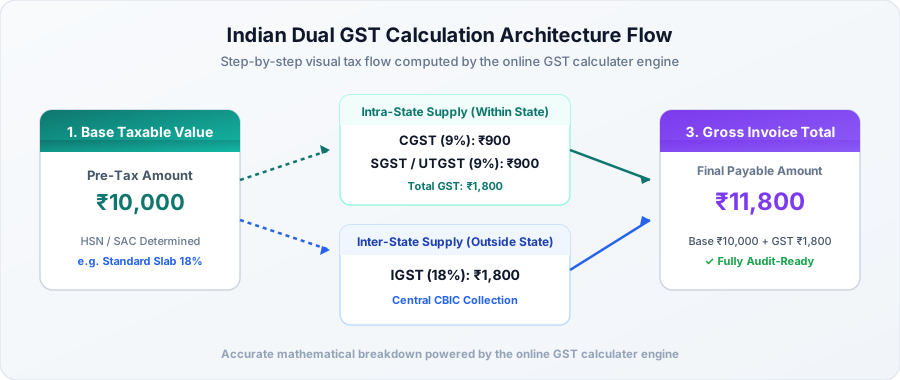
India operates on a concurrent Dual GST Model. When you sell goods or deliver services within the same state (an intra-state sale), the tax is shared equally between the Centre and that State as CGST (Central GST) and SGST (State GST). When you sell across state borders or import from abroad (an inter-state sale), a single consolidated levy called IGST (Integrated GST) applies.
Why did India choose this dual design instead of a single national tax? Because under the Indian Constitution, both the Union Government and individual State Governments have sovereign fiscal powers. Rather than one level of government collecting everything and distributing it later, both governments levy tax simultaneously on the exact same taxable base.
This reform dismantled the old maze of cascading levies—where a manufacturer paid Central Excise, then added State VAT on top of excise, followed by CST on inter-state transit and local Octroi at municipal checkpoints. Under GST, tax is charged only on the value added at each stage of the supply chain.
Component
Who Levies It
Applicable Transaction
Where Does the Money Go?
CGST
Central Government
Intra-State (Within same State or UT with legislature)
How to Calculate GST in India with a GST Calculator
Whenever you generate an invoice, follow these three practical steps to avoid audit disputes with the tax department:
1
Fix the Taxable Base Value
Start with the true transaction value. Deduct any genuine trade discounts shown on the face of the bill, and include packing, delivery, and handling charges before applying tax.
2
Identify the Correct HSN/SAC Slab
Match your product or service to its statutory rate: 0%, 5%, 12%, 18%, or 28% using our HSN code directory. Don't guess—check chapter headings.
3
Apply Place of Supply Rules
If buyer and supplier are in the same state, split into 50% CGST + 50% SGST. If in different states, charge 100% IGST. Verify with our GST calculator tool.
Input Tax Credit is the engine of the entire GST mechanism. When you purchase raw inventory, rent commercial office space, or pay for business telecommunications, the GST you pay to your vendor is not an operating expense. It is a credit balance recorded in your Electronic Credit Ledger on the GST Portal (gst.gov.in) that offsets the tax you collect on your outward sales.
However, claiming ITC is not automatic. Under Section 16 of the CGST Act, you must satisfy four statutory conditions:
Possession of a Valid Tax Invoice: You must hold a tax invoice, debit note, or bill of entry with full GSTIN details and mandatory Rule 46 particulars.
Actual Receipt of Goods or Services: You or your authorized agent must have physically received the goods or services.
Supplier Must Have Reported the Invoice: Under Section 16(2)(aa), the invoice must appear in your auto-drafted GSTR-2B statement. If your vendor forgets to upload their GSTR-1, you cannot claim the credit.
180-Day Payment Rule: You must settle the supplier's bill (value + tax) within 180 days from the invoice date. If you fail to do so, the claimed credit must be reversed along with 18% penal interest.
Set-Off Hierarchy for Input Tax Credit with GST Calculator
When preparing monthly GSTR-3B filings, tax credits cannot be offset randomly. The CBIC amended Sections 49, 49A, and 49B to enforce a rigid waterfall rule:
Step 1: Exhaust IGST Credit Completely: You must use your available IGST credit first against Output IGST. Any balance remaining must be utilized against Output CGST and Output SGST in any order or proportion until IGST credit is zero.
Step 2: Utilize CGST Credit: Once IGST credit is zero, use CGST credit to pay Output CGST. Any surplus CGST credit can be used against Output IGST. Crucially, CGST credit can NEVER be used to pay SGST.
Step 3: Utilize SGST Credit: Use SGST credit to pay Output SGST. Any surplus SGST credit can offset Output IGST. SGST credit can NEVER be used to pay CGST.
Why this matters: Failing to balance your CGST and SGST ledgers often forces businesses to pay cash under one head even while holding unusable credit under another. Always check your output split on our GST calculator before drafting tax returns.
In 95% of business transactions, the supplier charges tax on the invoice, collects it from the customer, and remits it to the government. This is called the Forward Charge Mechanism.
Under the Reverse Charge Mechanism (RCM) governed by Section 9(3) and 9(4) of the CGST Act, the legal obligation is flipped: the supplier does not charge tax, and the recipient must deposit the GST directly to the government.
Crucial RCM Rule That Many Taxpayers Miss:
Tax due under Reverse Charge cannot be adjusted against existing Input Tax Credit. It must be discharged in 100% hard cash via the Electronic Cash Ledger. However, once paid in cash, the business can immediately claim that exact amount as Input Tax Credit in the same month's GSTR-3B (provided the expense was incurred for business purposes).
Common business expenses that fall under statutory RCM in India:
A
Goods Transport Agency (GTA)
When hiring a transport operator who issues a consignment note and hasn't opted for the 12% forward charge route, the business paying freight must discharge 5% GST under RCM.
B
Legal Services from Advocates
Retainer fees, legal opinion charges, and court appearance fees paid to individual advocates or law firms are subject to 18% RCM payable by the business client.
C
Company Director Remuneration
Sitting fees, advisory fees, and commissions paid to non-executive, independent, or nominee directors (distinct from regular salaried employee payroll) attract 18% RCM.
Ensure 100% Tax Accuracy with our GST Calculator
Run quick, reliable invoice computations for both inclusive and exclusive scenarios with complete CBIC alignment.